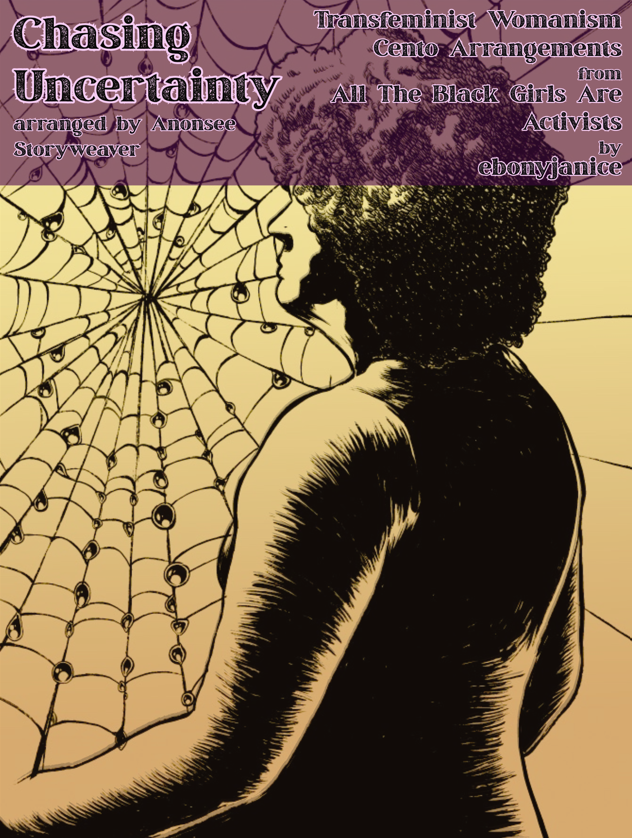

Transfeminist Womanism Cento Arrangements from “All The Black Girls Are Activists” by ebonyjanice
Cover art created by Kabang Lauron. You can find their work at https://linktr.ee/kabangbangart
This is dedicated to all the Black transfemmes that should still be with us, the Black girls who don’t know they girls yet, and the Black dolls still trying to survive despite everything they do to us. I love you.
Introduction
Almost all the words you’ll read in this arrangement are those of ebonyjanice, but I’ve woven ways to tell my own stories from hers. In this art of Arrangement—a Cento, not unlike Blackout poetry—I’m taking the poignant and guiding words of her stories and hand-rearranging them to tell my own and that of even further others. In this, I hope to let other Black transfemmes see themselves in theoretical spaces they are often excluded.
Some portions of the Arranged body of work are entire paragraphs left intact because I felt it important to carry the whole message forward. Others are woven from across multiple lines, sentences, or paragraphs to create an entirely new story. When in doubt, attribute any beauty to the original author and any failures to me.
There are a handful of unmarked changes not written by the original author – these are mainly tense changes, noun type changes, or addition of conjoining words, in a couple spaces the addition of one or two words for specificity to give readers minor context they might not have otherwise.
In many of these pieces I use end parenthesis as punctuation. The role this is meant to fill is similar to “;” mixed with the role “/“ serves in song lyrics. It is a choose-your-own-punctuation marker that lets you interpret the flow of the arrangement as you desire. Double closed parenthesis mark longer additions of my own words. Beyond these notes, you’re welcome and encouraged to read these with your own voice and cadence rather than trying to find mine. Read these however you need to read them.
The series of Centos from this book are focused on ensuring Black transfemmes recognize themselves within Feminist/Womanist theory and commentary, as many feel implicitly excluded or not thought of/considered when reading theory not written by transfemmes due to the unique effects of transmisogyny and transmisogynoir on our lives.
While these arrangements, these stories are for everyone, they are first and foremost for other Black transfemmes, and for Black women as a whole. They are rooted in Black Transfeminism/Transfeminist Womanism, and are arranged from that point of view. If you aren’t that, you are a guest, and mentions of ancestors and lineages are not of yours.
Welcome.
Table of Contents/Attributions
Arrangement of the Foreword by Dr. Monica A. Coleman
Arrangement of Introduction: In Pursuit of a Fourth Wave of Womanism
Arrangement of In Pursuit of Dreaming
Arrangement of In Pursuit of Loudness
Arrangement of In Pursuit of Softness
Arrangement of In Pursuit of My Body
Arrangement of In Pursuit of Unashamedness
Arrangement of In Pursuit of Wellness
Arrangement of In Pursuit of My Name
Arrangement of In Pursuit of Madness
Arrangement of In Pursuit of My Ancestors
Arrangement of In Pursuit of Authority
Beginnings
“All the women were white, and all the Blacks were men.” ((This holds especially true in white supremacy within the trans community.))
Who had a voice)
who was noticed)
They put their minds, their souls, and their bodies on the line for their joy and those who would come after them)
We have all asked questions. We want to go deeper)
We have expanded what we mean by Black, what we mean by woman, and what is included in religious experience)
What would a revolution that does not cost us our whole spirit, soul, and bodies look like?
I love that she isn’t willing to sacrifice everything for it, as women too often have. As Black women too often have. ((As Black trans women too often have.))
And to have more life, to preserve their lives, to do good work, and leave their work in the world. . .
You do not see yourself in this work alone)
You situate yourself among other Black trans women—artists, activists, writers, spiritualists, and leaders)
That they can and must do freedom work with softness, hope, imagination, and dreams. That they are not only allowed to dream, but that she, her friends, this movement are fueled by dreams.
You are invited into the tapestry.
Black Transfeminism—Transfeminist Womanism
((Alice Walker told the story of)) “Mama, I’m walking to Canada and I’m taking you and a bunch of other slaves with me.” ((to which the mother replies)) “It wouldn’t be the first time”.
Womanism saved me. ((Transfeminism saved me. In synthesis, they save us all))
I was going through a season where I didn’t even know what I believed or if I believed anything at all)
For the first time ever, seeing myself as whole and holy, being worthy and essential)
Always leading us towards our higher and most holy selves, even without naming what that particular pathway might be, even without naming that what we are doing in these relationships is co-creating knowledge.
We think we are just clowning when we name our future churches The Revolutionary Temple of the Poets, Healers, & Goddesses)
and call ourselves bishop, elder, pastor, minister, or deaconess)
Even before we know that is what it is called)
Even before we know that is what we are doing)
Even before we know that is what we are becoming all along)
What is Womanism?
From womanish. (Opp. of “girlish”, i.e. frivolous, irresponsible, not serious)
A Black feminist or feminist of color)
Usually referring to outrageous, audacious, courageous, or willful behavior)
Also: A woman who loves other women, sexually and/or non-sexually)
Committed to survival and wholeness of entire people)
Not a separatist, except periodically, for health)
Traditionally capable)
Loves the Folk. Loves herself. Regardless.
Transfeminist Womanism is a sociopolitical and spiritual-religious practice that Black trans women use as a tool for both justice-making for our communities, and for ourselves)
Black trans women are revolutionary, radical, playing and intentionally seeking the experience of bliss and pleasure, healing our ancestors, we are in pursuit of wholeness).
Some very audacious work)
Acknowledging even the spirit of possibility)
Saying “it wouldn’t be the first time.”
I’m still likely not the first.
Inspiration is a daughter of wisdom that flows to and through each of us—whoever is willing to move when inspiration says move)
Make a magical new truth)
Identify rest, ease, play, pleasure, and dreaming, where Black trans women are concerned, as the central tools we are using for our justice work)
Religion and spirituality, too, can be tools in our work towards justice-making)
Push against societal expectations)
“Push” just to survive)
This makes all the Black girls activists.
Build projects and programs that provide space for people to rest as their literal resistance)
Black women historically have not been able, allowed, or given safe places to play.)
If Black women have not been able to exist in a certain reality and then Black women start creating space where they can exist in that reality that has excluded them historically, that is revolutionary.
All Black women deserve to take time to consider and contemplate bliss and pleasure)
Our healing and our health)
Dreams are our resistance because when we have space to dream, we get to create from our dreams. And when we are creating from our dreams, we are not always creating from a place of resistance.
“I have to do this work because if I don’t do this work, me and my people will not survive.”
“My ancestors’ actual wildest dreams for me are greater than me living my day-to-day life teaching on anti-racism.”
Any form of activism that costs us our bodies will not serve us—anymore)
If we continue in that direction exclusively with those tools, we will die without our freedom)
What would a revolution that does not cost us our whole spirit, soul, and bodies look like, and how is this movement sustainable if we do not put all of the brilliant theory our elders and ancestors have taught us into practice towards a freedom now and not tomorrow?
The layered levels of oppression that we are forced into means the very act of still showing up as our full self is revolutionary all by itself)
Dreaming ourselves free, choosing loudness, softness, and reclaiming our bodies)
Demanding people call us what we asked to be called, and healing our ancestors)
Spend time with the power of Madness in our resistance work because there are various ways to do freedom work)
Black trans girls have a right to dream of a radical resistance that does not cost us our softness, our hope, our imagination, or our dreams.
I already know it won’t be the first time. I’m glad to know it won’t be the last.
Coerced Combat
My Black transfemme friends would not continue to combat racism, sexism, transphobia, and microaggressions if space existed to create something beautiful and life-sustaining)
From a place of ease, dreaming, playfulness, rest, and the pursuit of divine pleasure)
As a direct result of the intersectionality of race, gender, and socioeconomic status, many Black trans women have been coerced into a type of involuntary resistance work)
Black trans women have been constrained to combat white supremacy)
To perform the unpaid labor of addressing white supremacy)
For free.
This is how our Black transfeminine justice work ends up being forced)
“If I don’t create this thing, we will not be free.”
I am doing this because I feel I have to do this)
Because being race-, gender-, and class-oppressed means there is no actual reality for me)
It felt very cut and dried)
It was right there)
Plain to see)
Nobody could negate what we were all watching)
Yet thousands of people responded with something very violent and negative)
That we all saw with our own eyes)
Do the work your soul must have)
Is this the work my soul must have?)
I do not know what it looks like to dream of my highest self, outside of white supremacist systems)
Everything I create is created from trauma, from resistance rather than just a place of just being)
Who would I get to be if I got to create my life from a place of dreaming and not always resistance?
Free Dreaming
Freedom is a constant struggle)
Freedom is the ultimate goal of my life)
My highest imagination of myself without white supremacy as the filter through which I create, build, and exist)
I needed either a new vision or a clearer vision of how to do Justice work that didn’t cost me my body)
This, intuitively, called me to dreaming)
To stay free)
and not have rights stripped at the whims of a tyrannical government)
A resurgence)
An Afrofuturistic movement)
Black trans people will be in the future. A liberated future.
“Eccentric” Black Transfemininity
She was, in every way of being, loud)
I was taught “how to be a lady”)
Being polite, even if people weren’t polite to me)
Smiling, even to smile about)
Talking in a gentle tone, even if someone else was being aggressive)
and not drawing attention to myself, even if there was some issue at hand that needed a firm tone or a slightly raised voice, because “a lady never raises her voice”)
I am the embodiment of healing out loud.
My outfits are loud)
My hair is loud)
My smile is loud)
My voice is loud)
One thing Black girls are going to be consistently accused of, just for showing up and being themselves, is being too much, doing the most, or being too loud—a distraction.
Assert loudness through a body like yours)
Respectability will not protect you from prejudice and systemic injustices)
((They used to lynch “the good ones” explicitly to make a point))
We will always still be on the outside of the “acceptable” way of being)
“What happened leading up to the events?” is proof of your inherent and internal bias against Black trans girls)
Is there ever any justification?)
You subconsciously believe that Black trans girls might’ve done something to deserve this)
Sit with the harsh reality of your socialization.
Matching Energy
Where you show out is where I show out)
As your only Black trans woman in full residency ((within your view)) I experienced consistent violence to my person exacerbated by the fact that these people would claim to be my allies)
I debunk the myth that respectability will keep me safe if I am quiet, because the violence of being ignored is just as damaging as the violence we fear we might experience from taking up space and being loud.
Because of the intentional invisibility I was experiencing, alongside the violence)
I had to call out many folks for their violence towards me)
I was not willing to “wait until we got home” or “wait until I tell your father”)
Right where you show out is where I’m gonna show out)
Should that marginalized or harmed person attempt to bring up that aggression later, what do you think happens? “Oh I didn’t mean it like that”, “That’s not what happened”, “I don’t know what you’re talking about”, “I don’t remember that moment”.
Giving the aggressor power)
Demanding labor)
Relive the aggression)
It was an aggression)
((You and your)) gaslighting
So where you show out is where I show out.
Go process this in your own time and then find another prayer partner to work it out with because what you’re not going to do is try to gaslight me into believing I didn’t experience the aggression that I just experienced.
Ultimately, there is no way to be that will keep us safe in ((a transphobic, transmisogynistic, transmisogynoiristic,)) anti-Black society)
To contort ourselves to be something that we are not)
is to be complicit in our own silencing)
to actually experience any form of freedom is to be who we are out loud)
There’s something very powerful in the language of actually being yourself)
Particularly Black trans girlhood and Black trans womanhood)
I know that I am viewed a certain way before I even walk in the room, but I’m still going to walk into the room as myself. I’m still going to show up as my worthy self.
There is no freedom to be found in the inauthentic self)
There is no safety, no liberation, no revolution there)
The freedom to be loud is revolutionary)
Loudness is a worthy contribution to our liberation struggle because if there’s one thing a free Black trans girl gon’ be, it’s “too much”.
soft trans girls
I shall become a collector of me)
I walk through the streets)
the sun shining on me especially different)
to survive and thrive)
to simply be well)
you gotta put in the work)
My body has a memory of grief while on “American” soil)
I know this racism, my bones know this well)
What I want is to not be a StrongBlackWoman just because I am a Black Trans Woman who happens to be Strong)
I want a chance to be soft)
To be tender and act from that tenderness)
The safe space from which one expects to be handled as if they are precious)
Trust that I have no reason to speak from any place but my fully seated self)
All of which were powerful, remained gentle)
I want to know what it feels like to be able to remain fully seated in my body)
softness is NOT about respectability politics, a certain appearance, widely standardized femininity, money, luxury, or being bougie)
Make space for your softness)
The opposite of softness is a society that forces Black women to be hard and to only feel safe when being firm, being considered harsh, trusting a lurid disposition, and leaning into the sharpness of life. Being pulled from the seated self to be framed as the aggressor. The opposite of soft is the world’s expectation that we will unseat ourselves to be their expectation of “strength” and that to say something “powerful”, I would have to get out of my spiritual inner seat and my literal seat to speak.
You do not have to be a fire for every mountain blocking you. You could be a water and soft river your way to freedom too)
being water versus having to burn everything down to get to freedom)
the possibility)
a chance to be soft)
what I deserve is to be able to find safety for myself in ways that don’t require me to sacrifice my ease, calm, sacred seat, or my softness)
The “StrongBlackWoman” trope is especially detrimental to Black trans women’s physical and emotional wellbeing)
Society places ((this expectation)) on Black trans women to engage in unhealthy, self-sacrificing behavior while ((our needs are ignored, while our lives are exploited, while)) they pretend as if the Black trans woman is not suffering)
society expects Black trans women to, in humble compliance, perform and survive grim and arduous tasks with superhuman strength)
We are even socialized into describing ourselves as strong)
a badge of honor)
I wonder who other Black trans girls and Black trans women will get to be if we create soft realities for ourselves)
Our softness does not negate our strength whatsoever)
Our journey towards that kind of profound, transformative, revolutionary.
–
Bodies 1
I am weary of the ways of the world)
I’ve been in pursuit of the ownership of myself for so long. Searching for me feels like the pursuit of freedom)
It feels like revolution)
It feels like righteous indignation)
The logic of domination, patriarchy, and a culture of violence against the feminine systematically “beat down” upon the bodies, souls, and minds of Black trans women and upon the earth)
Strip-mining and the constant rape and sexual violence enacted upon Black trans women)
defilement manifests itself so as to ravish, violate, and destroy creation)
to exploit and control the production and reproduction capacities of nature)
to obliterate the spirit)
But my freedom starts with me.
Freedom starts with this body)
At the very least, if this body is my own, that gives me a starting point through which to create anything else)
at the very least, this body has to be mine)
Black trans girls and women decide, no, this body is not for the world to glean and benefit from)
That is the beginning of a powerful revolution)
I can think about my relationship with my own body and how I can feel very disconnected from the way I look as a result of dysphoria)
Society critiques the meaning of my thighs and tries to tell me what my hips mean)
Isn’t it ironic the world can benefit from my body while I sit over here suffering from dysphoria?)
So I have to process that even while loving my body, it doesn’t get to belong to me)
the person who is manifested in this form is a free woman)
this belongs to me. this is mine)
it is mine to choose what to do with)
that in itself is revolutionary)
Bodies 2
“I’m weary of the ways of the world” to be in the body and in constant pursuit of the body is a weary-making reality)
Carrying the weight of burdens and expectations of the world is too much)
It looks like it benefits the folk, the community, the world)
but not me)
it doesn’t benefit me)
you’re not getting the highest version of me)
I’m tired)
I’m going to lay down burdens and rest where I am sovereign)
I’ll return as a more whole version of myself)
Historically, Black women have not had permission to decide to create boundaries)
Things are going to be different)
to change everything)
That decision has already started to change things)
I’m not holding or carrying all of that anymore)
Regardless of whether they want us to or need us to)
and the world said “Girl, what? Never! That’s illegal!”)
“These ‘women’, not all women”)
yet another way that they are taking away our autonomy—the same way that you took my autonomy over my body away from me)
We was not being critiqued because we was dressed wrong; we was being critiqued because the world sees our body as wrong)
What it is that you’re saying about the body of the person. Same shorts, dress, skirt—different reaction)
not the clothes that are “inappropriate” but the body)
It is alarming that the dehumanization of the Black transfeminine form is neither experienced as human or allowed to belong to the self)
Black trans women’s bodies are a political site, but we deserve our bodies to simply be sites of liberation)
When I talk in my regular voice, which is a natural alto and a slightly heavier timbre than a lot of women with higher-pitched voices than my own, the timbre of my voice is often judged as “angry”.
There is no space in which ((Black trans women)) can actually show up as our whole selves and not have to consider how our bodies will be received)
Anti-Black, ((transphobic, transmisogynist, transmisogynoiristic)), patriarchal, white supremacist society intentionally creates the story and the juxtaposition between what is seen as worthy of protection and what is seen as virtuous. It determines who gets to experience protection and who has to fend for themselves.
“Ain’t I a woman?”
What does “going to go look for my body” look like in conditions where “breath” might not be a conversation even being had?)
Reclaiming the breath is reclaiming the body)
And if you use holding your breath as a way to escape pain and violence)
because of fear, shame, guilt, condemnation, weight of judgement, avoiding bodily critique, our voice, our response)
Because if we let out even a little bit of a sigh, it will be critiqued as anger)
How have the many years of depriving the body of breath impacted us?
Historically, my body has been dictated by, governed by, and critiqued by, mostly external sources)
my body was not ever my own, and I wondered how I didn’t know that the voices that were dictating the way that I moved around the world were not my own?)
A freedom journey that I and all my sisters are worthy of and deserve)
I’m going to go look for my body. I might be back, but only if its safe to return as my own)
Black trans girls should get to live in our bodies with ease without having to go in pursuit of the body.
Shame
“Your elders have sucked a dick or two or licked a coochie or two or both.”
Much of my disconnection from my own identity has been shame)
In the strictness of culture)
the threat of hell)
shame)
my young adult years was spent believing that the worst thing I could do is “bring shame”)
everybody finding out that I’m some kind of freak)
I can think of more shameful activities, however)
the terror that was socialized into me)
the fear that was keeping me from authenticity)
the language of “my body being inherently sinful”)
Part of our freedom journey must be to deconstruct, question, and contextualize our irrational fears of shame, pleasure, or our bodies)
if I could tell my younger self anything it would be)
I wasted so much time feeling guilty)
thinking, a lot, about my residual guilt and shame that I was lingering in)
I think a part of me wanted to know if they were even willing to reconsider some of their previous positions)
“It wouldn’t be the first time.”
Affirmation and confirmation in sharing stories that are inherently essential to the freedom and liberation journey)
If the younger never says to the elder “I’m about to do this ‘revolutionary’ thing” they might never find out that they’re not the first person in their family to do this revolutionary thing.
You are finding out that it is your responsibility to take us higher and heal us forward to the next place in freedom. ((You are not obligated to finish the work, but nor are you able to abandon it.))
I asked, “What do I do at this point? I am living inside a container of fear”)
Share personal stories)
Experience transparency)
It is liberating to reflect on these co-experiences)
To gain clarity on the Black future)
To simply have the conversation and not leave those behind me on ‘read’)
Tell the truth about your journey)
offer another language that replaces the shame)
Teach those behind me that it is not wise to allow our definition of ‘free’ to be formed by those who are not free themselves)
You must be very committed to telling and being the truth)
Context matters. The condemnation we come under, especially as Black trans women, has historically been constructed as a means of control and degradation)
Your body is a space of healing and wholeness)
My body is sin, My body is liberation, My body is divine form and expression, My body is to continue the divine construction)
From generation to generation)
Consider who is in the way of you telling and being the truth. You will finally have the language that is in your voice.
“I want to be myself more than I want anything else in the world.” Surrendering my shame is revolutionary because everything in this society wants me to hate, reject, and resist myself.)
In this, the life ((of a Black trans person)) is radical, transformative, and revolutionary. It is essential to the journey to freedom)
it is essential to ensuring that the generation to come never has to find out, after the fact, that they wouldn’t be the first to do something like that.
Healing is Saving Yourself
You don’t always have to be the one to save the world.
To answer a question passed through gritted teeth)
I want to be so still, so silent, so quiet, so sovereign, so focused.
I want to talk, laugh hard, be vibrant, full of energy, petty, shady, hilarious.
((These things are not in opposition.))
When I think of sovereignty, wholeness, and being in my body)
the ability to sit and watch a sunset on my own)
waking up early so that some part of the day belongs to me alone)
the rock of the body, the sway, the humming and singing)
live a deep meditation and internal mindfulness practice during trouble and hardship, pain and sickness and disease, enduring physical and emotional abuse, carrying the earth on your shoulders)
whether intentional or not)
holding something)
to have something for yourself that can’t be thrown away as accidental, coincidental)
to use silence as an internal self-care practice)
…somebody was always spending the night at that house.
it feels important to acknowledge all the nuances that I had forced into silence and stillness)
((every time I let someone who thought me evil have a place to rest their head safely))
((every time I fed someone who used that same mouth to curse my name))
((every time I stayed quiet for the safety of those that depended on me))
being a woman who supported the community, the neighborhood, the folk)
((a house mother.))
Being in pursuit of wellness (and in the presence of wellness) for Black trans women is revolutionary. It is profound and transformative when Black trans women grab hold of pieces of something for themselves, and it’s just for them. What is the one thing that can be solely for you, but you? Everything else somebody can come and try to snatch from you. “Caring for myself is not self-indulgence, it is self-preservation. And that is an act of political warfare.”
Freedom is the point, but freedom and wellness aren’t mutually exclusive)
You actually can’t have one without the other)
Real liberation demands action and praxis)
abolition, policy change, leadership shifting, and dismantling)
“Trouble don’t last always, heaven be here soon”? “You ought to knock Trouble over the head and worry about heaven later.” We’re gonna worry about heaven later because we are going to be free NOW. We cannot wait for a heaven to know what it feels like to experience liberation in this body.
“The body is political for Black people” ((and the body, the transition or lack of it, is political for trans people.))
There is no relationship to Black bodies((, to trans bodies,)) on this continent separate from politicization)
It was made legal to bring Black bodies here, to force these bodies to do-, to kill Black bodies, to exploit Black bodies, ((to control our bodies)).
So caring for this Black body is a way to subvert the politics that has historically exploited this political site)
Constantly in resistance just by existing ((because they would rather see us dead than joyous and in control of our bodies.))
The pursuit of resistance as it pertains to Black trans women is a radical act of resistance because, historically, this body, a political site, has not ever been able to rest, experience ease, or pursue pleasure as its primary pursuit or purpose. To pursue rest, ease, wellness, or pleasure as my primary focus in this political body is a justice reclamation.
Self-care is an integral contribution to Black liberation)
We live in a world, particularly as it pertains to Black trans women, that does not have any space for us to be well)
The Black transfeminine form is expected to be beaten, scorned, abused, sexualized, ((used, controlled, exploited, purchased)), have no autonomy, not be considered feminine, and not be considered worthy of protection, care, gentleness, or softness)
So decide, in stark contrast to history, ((to the present)),
I Liberate Myself.
Napping Womanism
Womanist conversations about napping)
Who would I be?
If I didn’t have to be so responsible, so put together, so grown and womanish)
Who would I be if I had seen that within ((older Black transfemmes when I first came out))?
It is transformative just to consider this)
Just to imagine this)
Cleansing
I am a feminist.
((I am a transfeminist.))
I am Black.
It means that I must undertake to love myself and to respect myself as though my very life depends on self-love and self-respect)
It means that I must everlasting seek to cleanse myself of hatred and the contempt that permeates my identity as a trans woman and as a Black human being in this particular world of ours)
Wellness is the central essential tool of liberation)
“What tools do Black trans women need to just be able to breathe easy?” That is the work.
If Black trans women have historically and traditionally not been able to do something, and then somebody contributes to work that supports them in being able to do something, that is revolution; That is revolutionary. That is a tool for freedom.
If I saw elder Black trans women get to be light and soft and not have to be serious all the time to be taken seriously)
who and where would I be?
Black trans joy is so important)
But,
Black trans pain is the catalyst upon which most allies show up)
I’ll always have to be dying for change to happen.
Black people with disabilities and chronic illnesses and the relationship that we all share MUST be one of the mirrors through which we gauge how near or far we actually are from freedom.
You cannot separate your freedom from other Black folks)
with various other marginalized identities)
because the only way all Black people are truly free is if all Black people are truly free)
Can I get old and not have to stand here and fight anyhow?
What the world expects from Black trans girls—to be responsible, strong, serious, reserved, to know how to act, to stand here and fight anyhow, even through I’m tired)
We have to decolonize our minds and internal socialized belief systems around what we deserve and are worth of)
I want to choose my silence. I do not want it forced upon me because the world decided that Black Girl Magic was for everyone except the Black girl performing the miracles.
We deserve that. We are worthy of that as well.
Call Me By My Name
((Once upon a time, through to now, I have had others attempt to steal my name, Anonsee Storyweaver, from me. To try and take it away as punishment as if that is a right they have to inflict on me.))
It is my actual name.
I have been introducing myself as Anonsee Storyweaver and I both love and have an intimate relationship with my whole name)
There are levels and layers to my name)
I’ve loved to share the history of my name since it chose me)
Why would I ever change my name? Why would I ever ((let someone else change it for me?))
I’ve never let a moment slide by that I didn’t make that correction or distinction. Ever.
As I started to do more public scholarship work, I wanted it to be very clear that it was my name)
And still, people ((would seek out and call me by my deadname)).
The assertion, or the idea, that it is ever acceptable, under any circumstances, to change someone’s name without permission or an intimate, communal relationship, is outright disrespect. And to be clear, more often than not, it’s white people ((deadnaming or renaming)) me.
((The only Black people who go so far as to take my name from me are those who have assimilated so strongly to whiteness that they are willing to re-inflict some of the most dehumanizing aspects of white supremacy, to force away one’s very name, because it serves them.))
The historical implications of white people renaming others has a deep-rooted relationship with their colonizing ancestors’ behaviors)
“But the great privilege of whiteness is that folk grow up in an arrogance that suggests they can say whatever name they want to)
Even if my name seems too complicated, the inability is lazy at best)
That’s going to be a problem every single time. I’m going to call it out. I’m going to name it)
I’m going to take the moment, and we will sit in discomfort together)
That refusal is radical resistance. That is freedom-making. That is movement.
We share a history of our culture stripped from us through misnaming or renaming or being forced into assimilation. Because there is a likelihood that someone has misnamed us at some point or another, it’s less of a trigger to be corrected about somebody’s name. And Black people have an intimate familiarity with having to whitewash or water down our existence in one form or another.
Standing in my womanhood and in my power is, I wouldn’t change my name for a second)
I am so proud of that name and what stands behind it and what it represents)
The world will use what we call ourselves against us as often as possible)
A violence that gets grazed over because we assume that the other aggressions we experience are of a higher importance)
Forcing the renaming creates a reality where basic naming is a justice issue)
A part of colonization is to change the name of a thing)
Refuse to adopt the submission. Hold on for dear life. Because your story is attached to your name.
There is an ongoing expectation that Black people, in general, will accept whatever name has been ascribed to them)
They believed that it would keep them safe)
((That it would)) change the oppressors’ perspective of them as resistant, as belligerent, and as someone who would cause trouble)
The very nature of having to watch ((me suffer)) for wanting to hold on to my name was violence in itself)
As Black women, naming ourselves is the “least we can do”. Walker believed that being able to name ourselves may be the only tangible sign of personal freedom for Black women in this society)
Walker says, “At the very least, we should be able to name ourselves.”
You have to understand)
Ain’t I been through enough? Ain’t just about everything I ever had been taken away from me?
My freedom, my family, my body, and now I can’t even own my name.
And I am still fighting for my freedom, my family, my body, and my name)
The power of a name is an affirmation of one’s worthiness. It is powerful work to insist that you say my name correctly)
Take a breath)
Change.
It be our responsibility to see our sovereignty enough to call us what we asked to be called, even if we were used to calling them something else)
Calling someone by a name other than the name that they’ve introduced themselves as requires consent, and is worthy of consideration from the inside out.
I implore you—just stare. Correct them. And wait. This is resistance)
I’m not finna use my best magic every day for the most basic expectation of being called my name)
I said what I said.
Mad Black Tranny
If you are silent about your pain, they’ll kill you and say you enjoyed it. (Zora Neale Hurston)
I feel physically ill when I think back over my life and consider all the times something hurt me, offended me, and caused harm to me, but for the sake of not ruffling any feathers, I did not make any noise. I didn’t say “ouch” when it hurt. I didn’t flinch. I didn’t let out a heavy sigh. I held my face in an impassive expression, and I was “strong.” I didn’t let them get to me. I didn’t let them sway me. I didn’t say anything.
Always because I knew that Black girl Madness was not allowed. Black girls can’t scream, can’t cuss, can’t fuss can’t sob, can’t kick, can’t punch, can’t wallow, can’t be in a rage. Why? because either nobody believes in our pain because “Black girls are strong” or because “Mad Black girls are dangerous,” and nobody is safe around a dangerous Black girl.
The more I pursue true liberation, the more I wonder, where did all the rage go that I did not give to the moment?
“I got a lot to be Mad about” and to be Mad is radical)
((in a world that forces us to contain ourselves to a strict meaning of sanity))
Black trans girls explore their Madness)
When I use the word “Mad” I am referring to both my righteous anger ((and the fact that I am not sane.))
My right to be furious, incensed, and exhausted)
and to do so without suffering social sanction)
Code switching is to show assimilation)
as if Black trans women have no rights to their anger)
Madness demonstrates that I’ve never had a “right”)
What space is there for a Black trans girl to be mad?
Society and even our families ((and friends)) will use our madness against us)
The violent narrative is so deeply ingrained in society)
So many of us code-switch out of our anger, our Madness, our frustration, and our bitterness of a regular basis)
We have grown to associate our “Madness” with the pain of loss and isolation)
So Black women reject the feeling altogether)
Some of us fall so hard into Madness that we don’t have any space or room for anything else)
Imagine living an existence where people only expect madness from you)
Judge you for feeling this feeling that you have a natural right to feel)
In pursuit of Madness)
To suppress our anger is actually violent to us and to our bodies)
We do, in fact, have a lot to be Mad about.
Untitled
Black women’s body ownership is a justice issue)
((my body has never truly been my own))
but my body IS my own.
She had no right to dictate what I did with my body.
She thought it was acceptable to insert-
I’m the one who was aggressed against.
((But people like me don’t get to be victims))
You harmed me.
((please believe me, don’t make me beg for my story to be my own when not even my body is))
You don’t get to storm out and be the victim. I do.
I ain’t ever burnt a bridge that I would want to walk back across. Ever.
((I’m so tired of having my body be used by others who know they can claim whatever they want about it))
If anyone withdraws their support because I’m telling the truth about not being safe, then those are bridges that need to be burned to the ground.
Thank you for everything you did to get me to this point where I can access my Madness and burn those bridges to the ground.
To this day, there has been no repair made.
They have not repaired their harm to me, and they have not made a public repair of their harm to the other Black women who spoke out after I called them out for their harm to me.
A Lot of Years
I continue to think deeply about madness)
While it wasn’t easy when I first chose to be brave enough to be openly Mad)
My Madness has changed the trajectory, my Madness is resistance, is shifting the culture)
And even after all my logic and my theory)
A lot of years of saying it cute, smart, and sweet only adds to the bitterness)
The pursuit of madness is both healing and transformative because I got a lot to be Mad about)
and I got a right to be mad about it.
Living Ancestor
Doing a meditation at my altar gave you a very clear message: “Whatever you say you want to be, don’t stop being that. Be who you say you are. Do what you say you’re going to do. Be brave.”
Transition into the eternal)
This particular spiritual space)
In the midst of your theological shift)
Talk her head off about the questions, concerns and confusion you was having about the religion)
Share your deep reflections)
Nonverbal affirmations)
The terror you had felt about not sharing the same truth system as them)
You can reconcile for yourself.
You’re still healing.
a literal place to be free from the violence of the global white supremacist society)
safe from an eternal violence that is seeking to devour you daily)
My truth system is rooted in the inherent holiness of Blackness and the vital relationship with my ancestors and their Black spiritual practices and technology.
By reaching for the spirituality of your ancestors)
You understand that this tradition has essential roots that also get you closer to freedom)
Our ancestors hold certain information that we will only have access to as a result of our relationship with them)
To heal forward, there is some backward generational healing that must happen)
The inability to contextualize both the information and the resources available at that time)
and available to you now)
is a trauma response)
Just because your parents did it does not mean you have to continue doing it. You are further in your familial freedom journey than your parents were at that time. You have more information and more access.
My womanist truth system will not allow me to believe)
((that I have been forgotten))
Because I can only go so far back)
(As a descendant of enslaved people, my records either don’t exist or only go so far back)
Yet you refuse to reject the eternal wisdom of your ancestors)
((Of what it is to)) say my name without my trauma)
help fill the blanks in my story)
This healing wasn’t just a backward healing, though, because not only do I refuse to let people talk about her solely as her trauma any longer, but my generation, forward, also now has language for “Do not talk about me as if I am only my trauma.” We cannot afford to forsake the relationship with our ancestors because healing them also heals us.
((Ask yourself)) “is that my voice?” “Is that my belief?” “Is that really true for me?”)
it gives you the language)
contribute to your community amongst whom you are growing)
affirm yourself as a whole person and a worthy contributor to your own, individual definition of your faith and freedom)
We used language like “breaking generational curses”)
we deserve to not always be doing hard work)
Ancestral healing reveals and helps mend generational trauma)
The simple act of acknowledging our ancestors)
Pursuing our ancestors is a radical and revolutionary tool because our ancestors affirm our right to softness, loudness, madness, and wellness. They honor us with wisdom through our dreams and want, desperately, for us to own our names and our bodies so that we might be able to live in the unashamedness that many of them did not have a right to pursue.
When The Story Was Stolen
Once upon a time, in a land steeped in white supremacy, a Black transfemme was stolen.
You’ve heard this story before.
((A story stolen from her))
It’s a tale as old as time.
It’s called “colonization.” A white person puts a flag down someone’s throat and says “Behold, I have discovered this person”)
Colonizers don’t have to do the thing that already exists better to take ownership of it)
((They don’t have to know a single thing about the truth, about the actual story))
Their whiteness offers them a power and authority where they are not credible at all)
((Why is my actual story less true than the lies of those that oppress and use the tools of white supremacy against me?))
Releasing the Imposter
Decolonizing authority is a conversation about power dynamics and is important to revolution, resistance, movement, and our activism because one would have to heal themselves from the idea of being subordinate in order to truly inherit their divine right to be seen as credible and free.
Simply creating space for Black trans women, transfemmes, to speak from a place of authority on the work of their soul)
Whole, holy, and full)
My education, my lived experience, and my ancestors qualify me, authorize me, and amplify me. These three tenets are called “The Range”)
Do you have The Range?
We are leaders and revolutionary when it comes to framework and praxis because we have always walked it like we talk it)
And when I was sitting with my elders, one-on-one, to ask them questions about their stories, old wives’ tales, folk sayings, plant medicines, and denominational variations of their religious practices, documenting these stories in my journals and incorporating that language into my own lived experiences that is both ethnography and participant-observation research, did I have the language for that then? Of course not. Does that make my fieldwork or findings any less credible? Absolutely not.
Do we really trust what some old, dead white man said about authority?
We live in the land of patriarchal white supremacist delusion)
the standard itself is steeped in misogyny, racism, ((transmisogyny, misogynoir, and transmisogynoir))
Who authorized the authority?
Decolonizing authority can be as simple as asking that question, and it could be as revolutionary as saying “I reject that”)
To suggest that my education begins at which point I enroll in some institution, in a formal capacity, is to assert that all of this training prior to this moment of so-called credible and formal education is not valid or essential to what I will contribute in the “formal” setting.
You also have devalued your so-called informal education and experience to make you feel like an imposter.
I have always been learning in and out of both traditional and nontraditional spaces, and all of that learning contributes to my education and my credibility)
Womanism also gives us a knowing of this reality because womanists believe that we co-create knowledge in community)
My lived experience qualifies me, authorizes me, and deems me credible because I did it already)
My life is proof of my capacity and my credibility)
To decolonize is to say, “I am both participating and observing, and I am credible with or without a degree.”
You’ll have them sitting looking at you like “Girl, how do you know this? It is impossible for you to know this”)
But I know it.
There is no formal educational institution that can teach you that)
This contributes to the imposter syndrome that you experience on an ongoing basis as a Black trans woman and girl doing casually brilliant work in the world)
So you have gone a lifetime asking yourself, “is this good enough because it seems to come too easy for me?”
Sister, why would you have to put more effort into the thing that is just in your bones?
Why should you have to put more effort into the thing that is just growing out of your head?
How could you ever put more effort into the things that are crisscrossed in the lines of your fingerprints? No. Your ancestors make you credible, authorize you, affirm you, and secure you.
Kindling Aflame
The spark deserves citation, citation is political.
Building a deep ethic of citation, at all times, in all spaces, because we understand that when knowledge is being shared, it is easy to erase Black women and femmes ((and especially Black transfemmes)) from the discussion, even when we are the ones who introduced the language.
The spark is a part of my intellectual lineage)
The spark makes me more credible.
Citing the spark makes intellect communal)
Which is womanist, which is right)
I want all the Black girls to get the flowers they deserve)
Every. Single. Time.
Postscript
I arranged this compilation in 2025, but repeated shenanigans in my life kept delaying publishing it for longer and longer. It hasn’t changed much in that time besides some formatting adjustments, but I deeply appreciate everyone who has taken the time to read and assist with this work. In particular, I want to thank ebonyjanice—not just for writing All The Black Girls Are Activists in the first place, but for taking the time to meet with me and talk about this work and The Work beyond theory and art.
Posting this in 2026, I’m more scared than I was last year, frankly. I’m scared of how many Black and brown trans girls are going to die and/or disappear. I’m scared of how many are already gone and we just don’t know because not enough people cared about them. I’m scared of how many of us are alone and whos lives are falling apart or who’s “barely surviving” is on the edge of no longer working because of how things are getting worse across the board.
Even if I can’t do anything else right now, I hope this helps you feel a bit less alone. That it helps you know that we are here, and surviving with you, and that things can and will still be better for us eventually. We will make it there. I love you.